Showing posts with label US. Show all posts

Saturday, 9 October 2010

Watch China and US in stand-off at climate talks

China and US in stand-off at climate talks


AFP/File – Smoke is seen rising from a chimmny in the northern port city of Tianjin where the UN Climate Change
TIANJIN, China (AFP) – UN climate talks were set to wrap up on Saturday with China and the United States locked in a stand-off, slowing down progress ahead of a major summit next month on global warming.
The major powers sparred throughout the six days of talks in the northern Chinese city of Tianjin, prompting the hosts to warn on the penultimate day that the atmosphere for negotiation had deteriorated.
"I want to emphasise no compromise... on the interests of developing countries," the Chinese foreign ministry's special representative for climate change, Huang Huikang, told delegates on Friday.
"We are losing trust and confidence."
Delegates from more than 170 countries attended the latest round of the long-running United Nations negotiations that are aimed at eventually securing a binding global treaty on how to limit and cope with climate change.
World leaders failed to broker such a treaty in Copenhagen last year as developed and developing nations battled over who should carry more of the burden in cutting greenhouse gas emissions that are blamed for global warming.
The Tianjin meeting was the last big gathering before an annual UN climate summit, which will be held in Cancun, Mexico, from November 29 to December 10.
Delegates reported that progress had been made on some specific issues in Tianjin, but many others also said that negotiations were not moving quickly enough to limit global warming below dangerous levels.
"We want to call for greater urgency in the negotiations," Dessima Williams, Grenada delegate and chair of the Alliance of Small Island States, told reporters on Friday.
"We have seen some movement, we are pleased with the engagement and the atmosphere, but there's much more that needs to be done and greater urgency is needed."
Chinese delegate Huang on Friday repeated China's long-held positions that for progress to be made the United States and other rich nations must commit to making bigger cuts in emissions of carbon dioxide and other greenhouse gases.
He said they must also give money and transfer technology to developing countries to help them cut their emissions and adapt to climate change.
"Now the key is there is a lack of substantive progress on the developed countries' side," Huang said.
The United States, meanwhile, has insisted all week that it will not provide climate funds unless the big developing countries such as China allow their greenhouse gas emission reduction efforts to be monitored and verified.
Coppied by http://news.yahoo.com/s/afp/20101009/wl_asia_afp/unclimatewarmingwrap

Thursday, 7 October 2010

Watch US official sees signs of inter-Korean engagement

US official sees signs of inter-Korean engagement


SEOUL, South Korea — North and South Korea are showing positive signs of improving relations, a U.S. diplomat said Thursday, but he cautioned that Pyongyang has yet to indicate it is serious about moving forward on denuclearization.
The two Koreas agreed last week to hold their first reunions in a year for families divided by the Korean War, while South Korea is considering a proposal by North Korea to hold talks aimed at restarting a stalled joint tourism venture.
Military tensions between the two sides remain high over the March sinking of a South Korean warship that Seoul and Washington blame on North Korea, which Pyongyang denies.
U.S. Assistant Secretary of State for East Asian and Pacific Affairs Kurt Campbell, on a brief visit to Seoul to meet South Korean officials, said that the two Koreas must resume dialogue.
"The first step has to be re-engagement between North Korea and South Korea," Campbell told reporters Thursday, noting "some signs of dialogue, engagement between North and South Koreas and we encourage that process to continue."
Campbell also called on North Korea to live up to its promises to give up its nuclear programs.
"I think we're also looking for a clear and demonstrable commitment on the part of the North Koreans to fulfill their commitments that they made on denuclearization in 2005," he added, referring to an agreement made in six-nation negotiations.
Campbell was in Seoul a week after North Korean leader Kim Jong Il's third son, Kim Jong Un, was promoted to top military and ruling party posts, signaling he is in line to succeed his ailing father.
Campbell's visit also came a day after an adviser to South Korean President Lee Myung-bak said in published comments that the threat posed by North Korea's nuclear program has reached an "extremely dangerous level."
Last week, the Washington-based Institute for Science and International Security said that satellite images from Sept. 29 showed new construction activity in the area surrounding North Korea's nuclear reactor at Yongbyon.
"The North Korean nuclear threat has, in reality, been accelerating and has now reached an extremely dangerous level," deputy national security adviser Kim Tae-hyo said, according to the JoongAng Ilbo newspaper. He confirmed the comments to The Associated Press, but declined to elaborate.
North Korea, which has active nuclear and missile programs, conducted underground atomic tests in 2006 and 2009, drawing tough international sanctions in response.
South Korea, along with the United States, China, Japan and Russia, have been negotiating with the impoverished country since 2003 to get it to dismantle its nuclear facilities, which they consider a threat to regional security.
Separately, North Korea has ordered its officials in China to pledge their allegiance to Kim Jong Un, a news report said Thursday.
"North Korean diplomats and traders in China are believed to be sending letters pledging their loyalty to Kim Jong Un and Kim Jong Il since last week" the Dong-a Ilbo newspaper said, citing an unidentified source in China.
The letters, which may also have been ordered in other countries, might be an attempt to bolster the transition, the source told the newspaper.
A North Korean official at the country's embassy in Beijing reached by telephone said he had no information. He spoke on condition of anonymity, citing internal policy.
Presidential adviser Kim also suggested that there is potential danger in the emergence of Kim Jong Un as heir apparent.
"Kim is young and lacks experience, so there is a chance that he might develop an appetite for yet another risk or be tempted to engage in provocation to prove himself to the outside world," the presidential adviser said.
Little is known about Kim Jong Un. For the first time, state media reported Tuesday on him observing military exercises with his father. The Korean Central News Agency also said in a report released early Thursday that he attended a concert with Kim Jong Il and other top party, state and military officials
coppied by http://www.chron.com/disp/story.mpl/ap/top/all/7235381.html

Friday, 27 August 2010

baghdad Quarter of US Iraq deaths due to Iran groups - envoy

Quarter of US Iraq deaths due to Iran groups - envoy
BAGHDAD (Reuters) - The new U.S. ambassador to Iraq said on Thursday he believed groups backed by Iran were responsible for a quarter of U.S. casualties in the Iraq war but that Tehran was not as influential in Iraq as thought.

More than 4,400 U.S. soldiers have been killed since the 2003 U.S.-led invasion, battling Shi'ite militia the U.S. military has long said were armed, funded and trained by Iran, and Sunni Islamist insurgents.

A soldier stands guard at the site of a bomb attack in Baghdad August 25, 2010. (REUTERS/Thaier al-Sudan)
The U.S. military will formally end its combat operations in Iraq on Aug. 31 as President Barack Obama seeks to fulfil a promise to U.S. voters to end the war, despite continuing insecurity and political instability in Iraq.

Ambassador James Jeffrey said Tehran had not been able to dictate the outcome of Iraqi coalition talks after an election in March, despite efforts and widespread beliefs that Shi'ite Iran gained unprecedented influence in Iraq after the invasion.

The ousting of Sunni dictator Saddam Hussein propelled Iraq's previously oppressed Shi'ite majority into power.

"My own estimate, based just upon a gut feeling, is that up to a quarter of the American casualties and some of the more horrific incidents in which Americans were kidnapped ... can be traced without doubt to these Iranian groups," Jeffrey said.

He said Iran has sought to use Iraqi proxies to destabilise its neighbour and make it inhospitable for foreign forces.

"But I don't see any long-term impact that it, however awful, has had on the development of politics and society here," Jeffrey told Western reporters.

"I believe ... that Iraqis are Iraqi patriots, that they do not want to be dominated or dictated to by anybody, not the United States, not Iran, not any of their other neighbours."

Coalition talks since the inconclusive election have failed to produce a government, despite early agreement between Iraq's main Shi'ite blocs to form a parliamentary alliance and efforts by Tehran to encourage Iraq's Shi'ite parties to unite.
Coppied by http://thestar.com.my/news/story.asp?file=/2010/8/27/worldupdates/2010-08-27T033048Z_01_NOOTR_RTRMDNC_0_-510970-1&sec=Worldupdates

Thursday, 26 August 2010

Enjoy Palin and McCain biggest winners in US primaries

Palin and McCain biggest winners in US primaries

LARA MARLOWE in Washington

SARAH PALIN and John McCain, who headed the Republican ticket in the 2008 presidential election, were the biggest winners in Tuesday’s primaries, 70 days before all-important mid-term elections that will renew the entire US house of representatives and one-third of the senate.

Their relative influence has been reversed, with Palin playing kingmaker in contests from Florida to Alaska, and McCain indebted to his former vice-presidential running mate for her support in fending off a challenger from the far right, populist Tea Party movement.

By the time ballots were counted yesterday morning, Palin could revel in confirmed victories for four candidates who she endorsed in Arizona and Florida, with an apparent fifth victory in her native Alaska.

Palin and the California-based Tea Party Express may have unseated Lisa Murkowski, one of the most powerful Senate Republicans, in the Republican primary in Alaska.

The Tea Party earlier triumphed in Nevada and Kentucky on a platform opposing taxation and government spending.

In league with Palin, the Tea Party propelled Joe Miller, a virtually unknown lawyer from Fairbanks who attended West Point and Yale and won a Bronze star in the 1991 Gulf War, to a surprise 1,960-vote lead over Murkowski, the scion of an Alaskan political family who have repeatedly clashed with Palin.

Definitive results will not be known for two weeks, when all absentee ballots have been counted.

Murkowski enjoyed a seemingly unassailable 37-point lead in an opinion poll last month, and far outspent Miller. Buoyed up by $600,000 (€473,000) in advertising money from the Tea Party, Miller portrayed Murkowski as the heir to a dynasty, and a pro-abortion liberal.

Palin made pre-recorded, automated “robocalls” on Miller’s behalf. “I am absolutely certain that [Palin’s support] was pivotal,” Miller told the Anchorage Daily News .

Murkowski blamed Palin for her probable defeat, saying, “I think she’s out for her own self-interest. I don’t think she’s out for Alaska’s interest.”

In Arizona, Palin played the opposite role, supporting McCain, the establishment Republican incumbent, over his Tea Party challenger.
coppied by http://www.irishtimes.com/newspaper/world/2010/0826/1224277610078.html

Watch As the US troops depart, bombs rip through Iraq

As the US troops depart, bombs rip through Iraq


US soldiers at the site of an explosion yesterday in Kut, 100 miles south-east of Baghdad. A suicide car bomber killed at least 19 people and wounded scores in the attack on a police station, a police officer said
Al-Qa'ida showed that it has the strength to strike all over Iraq yesterday by making a string of attacks that left at least 56 dead, half of them policemen and soldiers, and 250 wounded, across at least thirteen cities and towns.

The bombings came a day after the US cut the number of its troops in Iraq to below 50,000 and withdrew the last of its combat brigades. The attacks undermine the Iraqi government's claim to have succeeded in greatly improving security and weakening al-Qa'ida.

The heaviest casualties were in the city of Kut, 100 miles southeast of Baghdad on the Tigris river. A suicide bomber in a car penetrated security barriers and detonated his explosives between a police station and provincial government headquarters, killing 19 people, 15 of them policemen.
coppied by http://www.independent.co.uk/news/world/middle-east/as-the-us-troops-depart-bombs-rip-through-iraq-2062208.html

Watch Pakistan Taliban planning aid attack, says US official

Pakistan Taliban planning aid attack, says US official


Millions of Pakistanis have been displaced by the floods
The Pakistani Taliban are planning to attack foreigners helping with flood relief efforts in the country, a senior US official has warned.

The official also said "federal and provincial ministers" may be at risk.

Some UN agencies say they are now reviewing their security procedures.

It has now been four weeks since the start of the flooding, described as the region's worst humanitarian crisis. The UN says more than 17 million people have been affected by the floods.

Continue reading the main story
Pakistan's Monsoon Floods

Born amid the floodwaters
Aid effort painfully slow
In pictures: Pakistan's flood crisis
Forgotten humanity
As floods sweep down from the north, they are threatening to breach an embankment in the Kot Almo area in Sindh province, forcing thousands of people in the southern Thatta district to flee from their homes.

Throughout Pakistan, about 1.2 million homes have been destroyed in the monsoon floods, leaving 5 million people homeless.

Aid agencies are focusing on providing emergency relief such as shelter, food and medical care.

'Plans to attack'

The militant group Tehrik-e Taliban "plans to conduct attacks against foreigners participating in the ongoing flood relief operations in Pakistan", a US official, speaking on condition of anonymity, told the BBC.

There have been no such attacks so far, but Tehrik-e Taliban is considered the most radical and violent militant group in Pakistan.

A retired Pakistani general, Talat Masood, told the BBC that the militant group would seek to counter any gains in public support for Western governments helping with relief and aid work.
Protection and security

The warning came hours after a top US general involved in the military relief effort said his men had not encountered any security problems in flying aid to Pakistan.

It has been nearly a month since the flooding began
"We have seen no security threat whatsoever in the three weeks we have been operating here," Brigadier General Michael Nagata was quoted by the AFP news agency as saying.

He added that the Pakistani military had done a "highly effective job in providing our force protection and security".

Various nations have pledged more than $700m (£552m) for relief efforts in Pakistan.

Workers have begun clearing up as the floods recede in the north and the UN has appealed for more helicopters to reach 800,000 people who are cut off.
Coppied by http://www.bbc.co.uk/news/world-us-canada-11092868

Sunday, 22 August 2010

US backs Iranian nuclear plant

Enjoy US backs Iranian nuclear plant


THE White House has offered a guarded response to the Russian-built reactor at Iran's first nuclear power plant.

The US says that while it sees no "proliferation risk" the facility "should not be confused with the world's fundamental concerns with Iran's overall nuclear intentions".

The Russian involvement in the reactor, intended for civilian purposes, "underscores that Iran does not need an indigenous enrichment capability if its intentions are purely peaceful", US State Department spokesman Darby Holladay said yesterday.

Iran started loading fuel into its Russian-built first nuclear power plant over the weekend, a day after officials there declared victory for the country's nuclear program.

"With the launch of the Bushehr nuclear power plant, our country will be among the few states in the world with complete control and in full command of their nuclear fuel cycle," said Ali Asghar Soltanieh, Iran's top nuclear negotiator.


RELATED COVERAGE
Iran ups the ante in nuclear standoff
The Australian, 5 hours ago
No 'risk' from Iran's nuclear plant: US
The Australian, 1 day ago
Defiant Iran fuels up nuke power plant
The Australian, 1 day ago
'Three days to attack Iran'
The Australian, 4 days ago
Iran counts down to nuclear capability
The Australian, 8 days ago

The plant was built in 1974 before the Islamic revolution that toppled the shah. The project was largely abandoned in 1979 but was revived in 1995 after Iran signed a $US1 billion contract with Russia to help make the plant operational. Since then, international concern and suspicions that Iran might be pursuing nuclear weapons delayed the project. Iran says its nuclear program is for peaceful energy purposes and fuelling the plant is not banned under the UN sanctions against Iran.

The Obama administration, which has previously been critical of Moscow's role in Bushehr, has largely voiced support for the plant launch

"We recognise that the Bushehr reactor is designed to provide civilian nuclear power and do not view it as a proliferation risk," Mr Holladay said.

The reactor was "under IAEA (International Atomic Energy Agency) safeguards and Russia is providing the needed fuel and taking back the spent nuclear fuel, which would be the principal source of proliferation concerns."

However, a White House official stressed that US views on the Bushehr reactor "should not be confused with the world's fundamental concerns with Iran's overall nuclear intentions, particularly its pursuit of uranium enrichment".

Russia's supply of fuel to Iran is the "model" that Washington and its P5-plus-one partners - permanent UN Security Council members Britain, China, France, Russia and the US, plus Germany - have endorsed, Mr Holladay said. But he added: "It is important to remember that the IAEA's access to Bushehr is separate from and should not be confused with Iran's broader obligations to the IAEA on this score, as the IAEA has consistently reported Iran remains in serious violation of its obligations."

Meanwhile, Iranian President Mahmoud Ahmadinejad inaugurated the country's first domestically built long-range unmanned bomber yesterday. Dubbed the Karrar or striker, the plane was inaugurated on the national day for the country's defence industry.
Coppied by http://www.theaustralian.com.au/news/world/us-backs-iranian-nuclear-plant/story-e6frg6so-1225908571115

US security firm 'to pay $42m fine'

Enjoy US security firm 'to pay $42m fine'


By agreeing to pay the fines, Xe avoids criminal charges over violations of US export rules

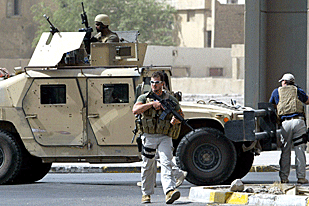
The private security contractor previously known as Blackwater, has agreed to pay $42m in fines for hundreds of violations of US export rules, according to the New York Times.

The violations included illegal weapons exports to Afghanistan, making unauthorised proposals to train troops in southern Sudan, and providing sniper training for police in Taiwan, the newspaper said on Friday.

The New York Times reported that by reaching the agreement with the US state department to pay the fines, the company avoids criminal charges over the violations of US export control regulations.

Name change

Blackwater, which provided guards and services to the US government in Iraq, Afghanistan and elsewhere, changed its name to Xe in 2009.

Paying the fines will allow Xe to continue to compete for government contracts, the New York Times said.

US export rules mandate government approval for the export of certain types of US military technology or knowledge.

But Xe "began to seek training contracts from foreign governments and other foreign organisations without adhering closely to American regulations", the newspaper reported.

It "also shipped automatic weapons and other military equipment for use by its personnel in Iraq and Afghanistan in violation of export controls, and in some cases sought to hide its actions", the New York Times said.

Black market

According to the daily, investigators were also looking at whether weapons shipped to Iraq were sold on the black market, ending up in the hands of the Kurdistan Workers' Party (PKK) that is fighting for independence from Turkey, a group considered by the US to be a terrorist organisation.

However, the settlement does not resolve other legal troubles still facing the company and its former executives and other personnel, the newspaper said.

Those issues include the indictments of five former executives on weapons and obstruction charges, a federal probe into whether company officials tried to bribe Iraqi officials, while at least two former employees face murder charges after two Afghans died in Kabul in May 2009.

A US court dismissed charges against former Blackwater guards accused of killing 14 Iraqi civilians in Baghdad in 2007.

Guilty pleas

A federal investigation into the company's weapons shipments to Iraq brought guilty pleas from two former Blackwater employees.

By paying fines instead of facing criminal charges on the export violations, the company will be able to continue to receive government contracts, according to the New York Times.

The newspaper quoted a company spokeswoman confirming the settlement but a state department spokesman declined to comment.

The New York Times noted that the company lost its largest federal contract last year, providing diplomatic security for US embassy personnel in Baghdad.

But it still has contracts to provide security for the state department and CIA in Afghanistan, the daily said.
Coppied by http://english.aljazeera.net/news/americas/2010/08/20108215276443958.html

Sunday, 15 August 2010

US stars dominate races at London Grand Prix


Watches this US stars dominate races at London Grand Prix
Americans David Oliver and Allyson Felix were the class acts on the second day of the London Grand Prix as British athletes once again struggled.
Oliver, the dominant sprint hurdler of the year, barrelled to a decisive victory in the 110m hurdles with a meeting record of 13.06 secs.
And Felix, winner over 200m on Friday night, added the 400m to her list of honours with a hard-fought win over Tatyana Firova and Debbie Dunn.
The home nation's medal-winning heroes from the European Championships again failed to translate their Spanish form to the colder conditions of south London and tough standards of the Diamond League.
The high points were personal bests for Eilidh Child in the 400m hurdles (by 0.01 seconds) and double bronze medallist Perri Shakes-Drayton in the 400m.
The muscular Oliver, who came within a whisker of Dayron Robles's world record in Paris in July, was clear off the second hurdle and went away from Dwight Thomas of Jamaica to add another race to his unbeaten run in 2010.
Oliver said afterwards: "I wanted that Diamond League title - that was my number one goal this season. I've finally been healthy this year and things are working out."


Three-time world champion Dwight Phillips was the class act in the long jump, making light of a difficult wind in front of the main stand to find a leap of 8.18m with his fourth round effort.
European bronze medallist Chris Tomlinson had a best of 7.92m in the same round for third behind Denmark's Morten Jensen. "I'm not happy with the jumps but I'm happy with the victory," said Phillips.
Wallace Spearmon dominated the men's 200m, pulling clear over the last 40 metres to win in 20.12 from Churandy Martina and Jaysuma Saidy Ndure.
Christian Malcolm, who was just one one-hundredth of a second away from European gold a fortnight ago, trailed home last in 20.81, with British team-mate Marlon Devonish in fifth.
Spearmon said: "I haven't won here since 2005, so it's great to come out on top here."
Britain's men also disappointed in the Emsley Carr Mile. Andy Baddeley had been strongly fancied for the European title but followed his poor performance in Barcelona with 11th place here, seven seconds down on winner Augustine Choge. Tom Lancashire was ninth.
The United States's Marshevet Myers was a surprise winner of a loaded 100m, holding off the favourite Carmelita Jeter and a field that included Sherone Simpson, Kelly-Ann Baptiste and Aleen Bailey in an impressive time of 11.01.
Myers said: "I had a great race and I'm now ready to go back to work. I knew it was going to be a hot race - the girls were very talented - so I just had to focus on my lane and running through the line."
New European champion Mariya Savinova kicked clear of Kenya's 2007 world champion Janeth Jepkosgei to win the 800m in 1:58.64, with Britain's Jemma Simpson coming through late for third.
Jenny Meadows, bronze medallist at the Europeans, was fifth with Lisa Dobriskey, normally a 1500m specialist, clocking a personal best of 2:00.14 in seventh.
Simpson was pleased afterwards with her 1:59.26. She said: "I'm getting there and getting more and more consistent - next year it's going to come."
Meadows was less happy with her display. "I made an absolute hash of that between 300m and 200m to go," she admitted. "I got boxed in and had to do a few steps almost on the spot. I was really annoyed with myself."
As well as a personal best it was a new Scottish record for Child as she clocked 55.16 for third in the 400m hurdles.
With Jamaica's Kaliese Spencer streaking clear, Child fought hard down the blustery home straight to hang on to second-placed Zuzana Hejnova, with European champion Natalya Antyukh down in sixth.
In the stadium where Britain's Steve Backley set the world record 20 years ago, Norway's Olympic, World and European champion Andreas Thorkildsen produced a throw of 87.38m to maintain his position atop the Diamond League rankings.


Germany's Matthias de Zordo was 41 centimetres back in second, with Finland's Tero Pitkamaki having to settle for third with a second-round effort of 82.24m.
Kate Dennison finished a respectable third in the pole vault, clearing 4.46m but failing with three attempts at a new British record height of 4.61m.
She was beaten on count-back by Brazil's Fabiana Murer and Israel's Jilian Schwartz, all three clearing the same height, but among her scalps was former world champion Svetlana Feofanova.
Russia's Ivan Ukhov, infamous for his drunken antics in Lausanne two years ago, took the high jump with 2.29m while Kenya's Milcah Chemos kicked past Yuliya Zarudneva to steal the women's 3,000m steeplechase on the line in a new meet record of 9 mins 22.49 secs.
There was also a personal best of 63.35m for Brett Morse, British discus number one, in a competition won by Olympic and world champion Gerd Kanter. The shot put was won by United States's former world champion Reece Hoffa with a season's best of 21.44m.
Coppied by http://news.bbc.co.uk/sport2/hi/athletics/8914660.stm

Saturday, 14 August 2010

about 200,000 hectares were on fire in Russia US helps Russia tackle wildfires


Watched being enjoy this US helps Russia tackle wildfires
The first US air force planes have arrived in Russia loaded with equipment to help tackle
wildfires that have been raging across vast areas of the country for weeks.

Two C-130 aircraft loaded with aid landed at a Moscow airport on Saturday as Russian officials said the ferocious blazes which have killed at least 50 people were beginning to be brought under control.

"After close consultation between the Russian government, the United States began the deliveries of fire fighting equipment valued at approximately $2.5 million ... to bolster Russia's fire suppression efforts," Eric Rubin, the US embassy charge d'affaires, said.

"These deliveries will include water tanks, pumps, hand tools, fire protective clothing and medical kits."

Valery Shuikov, the deputy head of the international department of the Russian emergencies ministry, welcomed the assistance.

"We will always remember this gesture, this arm that was extended to us at a very difficult time," Shuikov said at the Vnukovo airport.

Two further flights are due to arrive with more equipment in the coming days.
Coppied by http://english.aljazeera.net/news/europe/2010/08/2010814211230339273.html

Tuesday, 20 July 2010

Want to change populer US seeks Pakistan PR triumph

Watches this enjoy US seeks Pakistan PR triumph


Obama administration wants to change popular Pakistani perceptions of their country's role in 'America's war', but this may take more than grand gestures [GALLO/GETTY]
A preacher I once knew said something which has resonated with me ever since. "There is no end to the good you can do," he said, "provided you are willing to give someone else the credit."

No doubt, a substantial amount of good will come from the $500mn in new, large-scale US-funded infrastructure projects announced by Hillary Clinton, the US secretary of state, in Islamabad this week. But the secretary and other senior US officials have made it clear: They want to be sure the US gets the credit.

Ever since 9/11 and Pakistan's abrupt - if partial - policy shift in favour of cooperation with the US against al-Qaeda and associated militants, US officials have been seized of the fact that the US' overwhelming unpopularity among the Pakistani public was making it all the more difficult for Pakistani officials to vigorously prosecute a campaign against militancy.

Try as he might, Pervez Musharraf, the former Pakistani president, though genuinely convinced of the domestic necessity to combat extremism, could not develop popular support for what was seen as "America's war".

Grand gestures

IN DEPTH
More from Robert Grenier:

Petraeus faces Afghan conundrum
McChrystal's fatal error
The US and Karzai's little brother
'Condemned to civil war'
Non-proliferation regime 'bankrupt'
Ominous signs for US-Pakistan ties
Why Karzai cannot choose his family
US leadership in non-proliferation
Follow the chain of command
Talking to the enemy
Striking at Afghanistan corruption
Pakistan needs friendly Afghanistan
Political umbrage in Washington?
Making room for the Taliban
The Obama administration has made it clear that it wants to fundamentally change the Pakistani perception of its relationship with the US, both at the leadership and popular levels.

The administration sees the need to move beyond the "transactional" nature of past US-Pakistan relations, in favour of a "broad partnership" which it hopes will overcome the "trust deficit" and convince Pakistanis that the US will remain committed to them and the region long after the current unpleasantness with the Taliban and al-Qaeda have ended.

In conducting this uphill fight, the US has opted for the grand gesture. Not only is the absolute amount of civilian developmental aid contained in the so-called Kerry-Lugar-Berman bill impressively high - some $7.5bn over five years - but in implementing this programme, the US has decided to place considerable emphasis on mega-infrastructure projects including dams, hydroelectric power plants, irrigation projects, and large hospitals.

These projects make a great deal of sense in their own right. Pakistan is beset with crushing deficits in water and electric power; addressing them is key to economic growth and long-term political stability in a nuclear-weapons state in which extremism exerts a substantial appeal.

Moreover, moving beyond the uni-dimensional pattern of the Bush administration, which largely limited itself to military aid, counter-terrorism assistance and military reimbursement for Pakistani troop deployments, promises to expand the US relationship to encompass the civilian side of the leadership class, again with long-term benefits.

However, if US leaders believe that investment in high-profile development projects is likely to fundamentally alter popular Pakistani perceptions of the US, they are likely to be disappointed.

That is not to suggest that Pakistani perceptions of the US must always remain deeply negative; nor does it suggest that popular views of the US cannot be improved. That notion was strongly rebutted by the popular reaction to rapid US disaster relief assistance - much of it delivered by the US military - to Pakistani earthquake victims in the Northern Areas and Kashmir in 2005.

The images of US helicopters carrying desperately-needed humanitarian assistance to devastated areas produced a very marked, though temporary, upswing in popular perceptions of the US. But large-scale, multi-year projects whose impact on the lives of ordinary Pakistanis will be incremental and difficult to trace will simply not have a commensurate impact on popular perceptions.

In these more ambiguous circumstances, which lack the emotional impact of placing food into the hands of a hungry child, the reflexive reaction of many Pakistanis will be that US largesse toward Pakistan must be meant to serve US interests, and that the benefit to ordinary Pakistanis is incidental to that larger purpose.

Even the $100mn earmarked to expand bank credit to small and medium-sized businesses is likely to be so heavily intermediated by Pakistani institutions as to blunt the public relations benefit to the US.

This is precisely in line with the current US experience in Afghanistan, where the local political impact of US development assistance seems to be inversely proportional to the size and ambition of the project.

For example, all the money invested by the US in newly-refurbished road systems in Afghanistan has generated very little gratitude on the part of Afghans, either toward the Americans or toward the Afghan government. Conversely, very modest projects selected and conducted with determinative input from people at the village level, and with local engagement in their administration, have had a far greater political effect, especially in terms of the return on dollars invested.
Misaligning cause and effect

Finally, it must be said that the US is not aided in its efforts by the fact that its interest in Pakistan is substantially - perhaps fundamentally - transactional.

While the US has a clear national interest in a more stable and prosperous Pakistan, the impetus for its current aid programmes - transparently so - is provided by the situation in Afghanistan and by the war on terror, of which the Afghanistan counterinsurgency campaign is currently the preeminent part.

Here too, the US is misaligning cause and effect: Pakistani policy toward Afghanistan will be driven by Pakistani perceptions of its interests across the Durand Line; and the domestic Pakistani campaign against extremists will be driven by Pakistani perceptions of threat, greatly changed by the recent Taliban infestation of Swat and the mass terror attacks on Pakistani civilians, and not by perceptions of the US.

This is not to suggest for a moment that the US investment in Pakistani economic and social development is a mistake: Far from it. But like so much of US policy, its ultimate benefit to US interests will necessarily be indirect, and will take the form of bolstering responsible Pakistani politicians whose stock is dependent on their ability to deliver for the people, and who are better served politically when seen at least to be gaining a dividend for Pakistan when providing support for "America's war".

Coppied by http://english.aljazeera.net/focus/2010/07/201072073415371952.html