Showing posts with label security. Show all posts

Saturday, 9 October 2010

Watches this National security shuffle: Jones out, Donilon in

National security shuffle: Jones out, Donilon in


AP – President Barack Obama watches as outgoing National Security Adviser James Jones, center, shakes hands …
y BEN FELLER, AP White House Correspondent – Sat Oct 9, 2:20 am ET
WASHINGTON – Gen. James Jones, the gruff-talking military man President Barack Obama drafted as his national security adviser, announced Friday he was quitting after a tenure marked by ambitious foreign policy changes and undercurrents of corrosive turf battles.
Jones will be replaced by his chief deputy, Tom Donilon, a former Democratic political operative and lobbyist who in many ways is already the day-to-day leader of the White House national security operation. The move deepens a season of White House turnover near the midpoint of Obama's term, with White House chief of staff Rahm Emanuel departing last week, chief economic adviser Lawrence Summers leaving by year's end and other changes expected before long.
Obama described the transition from Jones to Donilon as expected and seamless, thanking both men in a sunny Rose Garden ceremony. The president put an emphasis on the patriotism of Jones, a Marine who served in Vietnam and retired as a four-star general after a career of more than 40 years. The two barely knew each other when Jones took the post.
As Obama's chief national security aide, Jones served during a time when Obama has sought to reshape American foreign policy on many fronts, from ending the combat mission in Iraq to expanding the war in Afghanistan to attempting to improve relations across Europe and Asia.
Jones had quiet clout but found himself in a world of squabbles given the competing demands, ideas and personalities in the government and the challenge of trying to coordinate them through the National Security Council. Questions always seemed to loom over whether Jones' vast military experience translated as Obama had hoped into the job of national security adviser, which requires informing and counseling the president and coordinating views from agencies.
"Jim has always been a steady voice in Situation Room sessions, daily briefings and with meetings with foreign leaders," Obama said. He added that Jones had represented the U.S. before its allies in every region of the world, and he said the American people owe the general a debt for making the nation "safer and stronger."
Jones, 66, is expected to serve in the job for about two more weeks. He recalled that he met Obama just over two years ago and that he was persuaded to join him because of the Obama's desire to take on the hardest issues of the day in a difficult time for the nation.
The general said, "I believe that where we are today in the global playing field and how the United States is held in the esteem of the rest of the world is an accomplishment that I frankly find astonishing in such a short period of time." To Obama, he said: "Thank you for letting me be a part of it."
Donilon's promotion has a significant spillover effect on the rest of the White House. He had emerged as a top candidate to replace Emanuel as the permanent chief of staff. Now that job appears even more likely to go to Pete Rouse, the newly installed interim chief and a longtime adviser to Obama.

Coppied by http://news.yahoo.com/s/ap/20101009/ap_on_go_pr_wh/us_obama_national_security_adviser

Friday, 8 October 2010

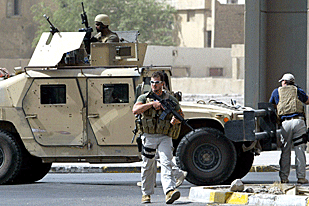
Watch Afghan security contractors 'fund Taliban

Afghan security contractors 'fund Taliban
Heavy US reliance on private security in Afghanistan has helped to line the pockets of the Taliban, a US Senate report says.


Private security guards are often used to guard compounds or convoys

The study by the Senate Armed Services Committee says this is because contractors often fail to vet local recruits and end up hiring warlords.

The report demands "immediate and aggressive steps" to improve the vetting and oversight process.

Continue reading the main story
Taliban Conflict

Who are the Taliban?
Q&A: Fighting the Taliban
Challenges for Afghan forces
Suspicion over Nato tanker attacks
Some 26,000 private security personnel, mostly Afghans, operate in Afghanistan.

Nine out of 10 of them work for the US government.

Private security firms in Afghanistan provide guards for everything from diplomatic missions and aid agencies to supply convoys.

In August, Afghan President Hamid Karzai gave private security companies four months to end operations in Afghanistan.

'Mr White'
"All too often our reliance on private security contractors in Afghanistan has empowered warlords, powerbrokers operating outside Afghan government control," Democratic Senator Carl Levin, chairman of the Senate committee, said.

Continue reading the main story
Analysis

Dawood Azami
BBC World Service editor, Kabul
The US Senate investigation confirms President Karzai's view that private security firms undermine Afghanistan's police and army.

Preparations are under way to absorb most members of security firms into the two forces.

But the police and army already struggle to find new recruits; one reason for this is that a private security guard can earn four times as much compared to a policeman.

The US has said it shares President Karzai's goal to close security firms, but wants to move more slowly than his target of the end of 2010.

President Karzai's decree allows embassies and other international offices to keep private security guards inside their compounds.

The plan is that, after the closure of security firms, Afghan security forces will escort supply convoys and other foreigners working in the country.

"These contractors threaten the security of our troops and risk the success of our mission," he added.

The report found that some contractors have had little training, while others were warlords linked to "murder, kidnapping, bribery and anti-coalition activities".

The document gives several notorious examples, including a man the Americans nicknamed Mr White - after a character in the violent film Reservoir Dogs - and his two brothers.

Mr White, who was hired to help guard Shindand airbase in the western Afghan province of Herat, was killed in 2007 by a rival Afghan security contractor.

The Americans then employed his brother, who was known as Mr White II. He is suspected of having funded the insurgents, and was eventually killed in a US raid on a Taliban meeting.
Cppied by http://www.bbc.co.uk/news/world-south-asia-11498443

Thursday, 7 October 2010

Watch Security contractors in Afghanistan 'fund Taliban'

Security contractors in Afghanistan 'fund Taliban'


Private security guards are often used to guard compounds or convoys
Heavy US reliance on private security in Afghanistan has helped to line the pockets of the Taliban, a US Senate report says.

The study by the Senate Armed Services Committee says this is because contractors often fail to vet local recruits and end up hiring warlords.

The report demands "immediate and aggressive steps" to improve the vetting and oversight process.

Some 26,000 private security personnel, mostly Afghans, operate in Afghanistan.

Nine out of 10 of them work for the US government.

Private security firms in Afghanistan provide guards for everything from diplomatic missions and aid agencies to supply convoys.

In August, Afghan President Hamid Karzai gave private security companies four months to end operations in Afghanistan.

'Mr White'
"All too often our reliance on private security contractors in Afghanistan has empowered warlords, powerbrokers operating outside Afghan government control," Democratic Senator Carl Levin, chairman of the Senate committee, said.

"These contractors threaten the security of our troops and risk the success of our mission," he added.

The report paints a disturbing picture of how some of those hired have little training or experience in firing weapons, while other contractors are warlords with known links to the Taliban, the BBC's Steve Kingstone in Washington says.

The document gives several notorious examples, including a man the Americans have nicknamed Mr White - after a character in the violent film Reservoir Dogs.

He is said to have funded the Taliban and to have hosted a meeting with a senior commander responsible for a wave of roadside bombs targeting Nato troops.
Coppied by http://www.bbc.co.uk/news/world-south-asia-11498443

Sunday, 22 August 2010

US security firm 'to pay $42m fine'

Enjoy US security firm 'to pay $42m fine'


By agreeing to pay the fines, Xe avoids criminal charges over violations of US export rules

The private security contractor previously known as Blackwater, has agreed to pay $42m in fines for hundreds of violations of US export rules, according to the New York Times.

The violations included illegal weapons exports to Afghanistan, making unauthorised proposals to train troops in southern Sudan, and providing sniper training for police in Taiwan, the newspaper said on Friday.

The New York Times reported that by reaching the agreement with the US state department to pay the fines, the company avoids criminal charges over the violations of US export control regulations.

Name change

Blackwater, which provided guards and services to the US government in Iraq, Afghanistan and elsewhere, changed its name to Xe in 2009.

Paying the fines will allow Xe to continue to compete for government contracts, the New York Times said.

US export rules mandate government approval for the export of certain types of US military technology or knowledge.

But Xe "began to seek training contracts from foreign governments and other foreign organisations without adhering closely to American regulations", the newspaper reported.

It "also shipped automatic weapons and other military equipment for use by its personnel in Iraq and Afghanistan in violation of export controls, and in some cases sought to hide its actions", the New York Times said.

Black market

According to the daily, investigators were also looking at whether weapons shipped to Iraq were sold on the black market, ending up in the hands of the Kurdistan Workers' Party (PKK) that is fighting for independence from Turkey, a group considered by the US to be a terrorist organisation.

However, the settlement does not resolve other legal troubles still facing the company and its former executives and other personnel, the newspaper said.

Those issues include the indictments of five former executives on weapons and obstruction charges, a federal probe into whether company officials tried to bribe Iraqi officials, while at least two former employees face murder charges after two Afghans died in Kabul in May 2009.

A US court dismissed charges against former Blackwater guards accused of killing 14 Iraqi civilians in Baghdad in 2007.

Guilty pleas

A federal investigation into the company's weapons shipments to Iraq brought guilty pleas from two former Blackwater employees.

By paying fines instead of facing criminal charges on the export violations, the company will be able to continue to receive government contracts, according to the New York Times.

The newspaper quoted a company spokeswoman confirming the settlement but a state department spokesman declined to comment.

The New York Times noted that the company lost its largest federal contract last year, providing diplomatic security for US embassy personnel in Baghdad.

But it still has contracts to provide security for the state department and CIA in Afghanistan, the daily said.
Coppied by http://english.aljazeera.net/news/americas/2010/08/20108215276443958.html

Friday, 20 August 2010

With McAfee deal, Intel to bake in security


We are this watch With McAfee deal, Intel to bake in security
In the future, you may not have to buy antivirus software for your laptops and mobile devices if Intel is able to live up to the promise of integrating technology from acquisition target McAfee, experts said on Thursday.
In announcing its plans to acquire security company McAfee for $7.68 billion, Intel executives said they see security as being as critical to computing as performance and connectivity and that they plan to combine security with its hardware and expand further into the mobile market.
While Intel has been pushing more and more functionality down into the chips, a marriage with McAfee will mark a shift away from the security firm's traditional product strategy, experts told CNET.
"Delivering security in Intel products and platforms is a huge departure from the way McAfee has delivered security technology in the past, as an add-on software product to an insecure platform," said Chris Wysopal, chief technology officer at Veracode. "This is where security needs to be, baked in."
The strategy dovetails nicely with the fast adoption of mobile devices and the more guarded move to cloud computing, where data is stored on remote servers instead of on local computers and accessed over the Internet, he said.
"I think this acquisition shows the critical importance of security in our now mobile, increasingly cloud-based, everything-always-connected world," he added. "Everyone building hardware and software needs to be thinking about the security of those products from the very beginning of their design, and customers are going to demand it. Anything less is not going to cut it in the computing environment of today."
For businesses in the mobile security market, the deal is seen as further validation that they are on the right track.
"Intel's acquisition of McAfee signals to the industry that smartphones and other connected devices are joining the web of devices we trust with critical data and that these devices need to be protected," said John Hering, chief executive of Lookout. "We have seen threats rising across the major mobile platforms and expect this trend to increase as mobile devices continue to become the dominant computing platform."
Don't expect to see security software hardwired onto the chip, said Tim Bajarin, president of analyst company Creative Strategies. Rather, there will likely be a bridge on the core CPU (central processing unit) to a security element, much like there are bridges to additional graphics chips and modems, he said.
"This particular deal allows Intel and McAfee to work together to tie future generations of software security to the processor via some sort of SOC (system-on-a-chip) solution," Bajarin said. "Today if a hacker wants to come into a system it almost always is done through software. But Intel and McAfee are capable of adding even another level of security, which would make a hacker have to break the hardware code as well as the software code."
McAfee will still sell antivirus and other security software, but their work with Intel could change the technology landscape fundamentally down the road, according to Bajarin.
"Intel becomes their strategic partner for them to innovate with on next-generation security software that can go all the way down to the chip level, and that has not been done yet by anybody," he said. "It will be fascinating to watch not only how they innovate, but how they go about securing everything from servers and PCs to wireless devices. That will be their challenge."
Marc Maiffret, chief technology officer at eEye Digital Security, predicted Intel would add the security in hardware at the device level but not necessarily at the chip level, while eventually phasing out McAfee's software-based products.
"TVs and other devices and cars continue to have more and more embedded Internet connectivity and really are becoming computers, and Intel sees the opportunity to bring McAfee's intrusion prevention and antivirus across all the devices," he said. "Intel was in the antivirus security market in the late '90s with the LANDesk product, but they sold it off to Symantec, so they definitely are not going to be getting back into that classic security software business."
Several analysts questioned why Intel executives felt they need to acquire McAfee to get the security enhancements in future products when they already have development partnerships with McAfee and others.
"I think it's going to be more of a chipset assist than embedding everything in the chip," said Josh Corman, research director for enterprise security at The 451 Group. "And many of those opportunities will be open to McAfee's competitors...and have been happening with joint development. They are going to continue to have multiplatform support."
Peter Firstbrook of Gartner was similarly skeptical.
"If Intel creates some firmware hooks for McAfee to exploit, then other security vendors can exploit those APIs as well," he said. "Most significantly, all the antimalware vendors have had security products for cell phones for years, but nobody has been willing to pay for it because the threat environment has been relatively benign and the ISPs or device manufactures are building security into the network or the device."
The shift to "baked-in" security and the focus on integration that the deal will require will definitely impact McAfee's existing business, Chris Silva, a senior vice president of research and service delivery for research firm IANS, predicted in a blog post.
"We'll see a stagnation of innovation for McAfee's existing product line and a drain of talent who leave the company seeking greener pastures at smaller, more-focused vendors that are iterating on a product and security approach," he said.
Coppied by http://news.cnet.com/8301-27080_3-20014175-245.html?tag=topStories1

Thursday, 19 August 2010

The president is vowing not to privatize Social Security


The president is vowing not to privatize Social Security, but to resolve its enormous cash flow problems permanently, he risks angering liberals who believe a solution can wait. Keith Hennessey on his options.

A Democratic split is coming on Social Security.
On one side is the president, who said Tuesday in Ohio, “I have been adamant in saying that Social Security should not be privatized and it will not be privatized as long as I am president…The population is getting older, which means we’ve got more retirees per worker than we used to. We’re going to have to make some modest adjustments in order to strengthen it… And what we’ve done is we’ve created a fiscal commission of Democrats and Republicans to come up with what would be the best combination to stabilize Social Security not just for this generation, but the next generation. I’m absolutely convinced it can be done.”
On the other side we have Paul Krugman, who wrote in The New York Times earlier this week, “The program is under attack, with some Democrats as well as nearly all Republicans joining the assault. Rumor has it that President Obama’s deficit commission may call for deep benefit cuts, in particular a sharp rise in the retirement age.”
If doing so is the only feasible legislative path to addressing this critical policy problem, will the president be willing to lead?
Krugman continues, “Social Security’s attackers claim that they’re concerned about the program’s financial future… Instead, it’s all about ideology and posturing… To a large extent they rely on bad-faith accounting. But [conservatives] receive crucial support from Washington insiders, for whom a declared willingness to cut Social Security has long served as a badge of fiscal seriousness, never mind the arithmetic.”
While Krugman names Obama fiscal commission co-chairman Alan Simpson, he also is targeting Democrats such as fiscal commission chairman Erskine Bowles and House Majority Leader Steny Hoyer.
Let’s look at how a Social Security deal might come together, first in the president’s commission and then on Capitol Hill.
A few conservatives who say that personal accounts alone can fix Social Security will oppose any deal that includes changes to benefit spending promises or tax increases, so they’re on the outside no matter what. That group is small but could cause a little trouble by (incorrectly) promising gullible and nervous conservative members of Congress that a free lunch solution is theoretically possible.
For most Republicans, three things are important: permanently solving Social Security’s cash flow problem, not raising taxes, and allowing younger workers to voluntarily redirect some of their current payroll taxes into personal accounts. Republicans know these “carve-out” accounts are anathema to most Democrats and impossible with a Democratic president. To pick up enough Republican support to be viable, a deal must therefore significantly, if not permanently, address Social Security’s long-term cash flow problem and must not raise taxes. If a proposed deal includes tax increases, I think all but a few Republicans will walk away. To get a deal, Republicans might split evenly on carve-out accounts, but they won’t split on tax increases. The president gets a win by blocking “privatization” (carve-out personal accounts), while Republicans get a win by not raising taxes. The reduction in, if not elimination of, Social Security’s long-term financing problem would be a bipartisan win for which both sides would claim credit.
If I’m right about Republicans on personal accounts and taxes, Democrats will split. Many Democrats would naturally oppose a deal that only slows spending growth and does not raise taxes, even if that deal excludes the carve-out personal accounts they oppose.
Coppied by http://www.thedailybeast.com/blogs-and-stories/2010-08-19/obamas-social-security-challenge-anger-democrats-on-reform/?cid=bs:archive1

Tuesday, 20 July 2010

Watched the Karzai reaffirms 2014 goal for Afghan-led security

We are see this Karzai reaffirms 2014 goal for Afghan-led security


KABUL, Afghanistan (AP) -- President Hamid Karzai on Tuesday reaffirmed his commitment for Afghan police and soldiers to take charge of security nationwide by 2014 and urged his international backers to spend their money on long-term Afghan priorities.

Karzai spoke at a one-day international conference on Afghanistan's future that comes at a critical juncture: NATO and Afghan forces have launched a major operation to drive the Taliban out of their strongholds, and the insurgents are pushing back. Rockets fired at the Kabul airport Tuesday forced the diversion of a plane carrying U.N. Secretary-General Ban Ki-moon and Sweden's foreign minister.

Wearing a traditional striped robe and peaked fur hat, Karzai said that Afghanistan and its Western allies share "a vicious common enemy." But, he said, victory will come in giving Afghans as much responsibility as possible in combatting the insurgency within its borders. He was flanked by international diplomats including Ban and U.S. Secretary of State Hillary Rodham Clinton.

"I remain determined that our Afghan national security forces will be responsible for all military and law enforcement operations throughout our country by 2014" - more than three years after President Barack Obama's date for the start of an American troop drawdown, Karzai said.

NATO Secretary-General Anders Fogh Rasmussen said the alliance will never allow the Taliban to topple the government of Afghanistan. He said that transition to Afghan-led security would be based on "conditions, not calendars."

"Our mission will end when - but only when - the Afghans are able to maintain security on their own," Fogh Rasmussen said.

Karzai also expressed his government's desire to take charge of more of its affairs. He asked his international partners to channel 50 percent of their foreign assistance through the government within two years. He also urged them to align 80 percent of their projects with priorities that have been identified by Afghans.

"It is time to concentrate our efforts on a limited number of national programs and projects to transform the lives of our people, reinforce the social compact between the state and the citizens," Karzai said.

While the international community recognizes that Afghans must increasingly take charge, corruption remains a major concern. Graft feeds frustration with the government that boosts support for the insurgency.

Clinton recognized that Karzai's administration had taken steps to fight corruption, but said more needed to be done.

"There are no shortcuts to fighting corruption and improving governance. On this front, both the Afghan people and the people of the international community expect results," she said.

Obama has said he wants to begin withdrawing American troops in July 2011. Though he has stressed the timetable is dependent on security conditions, it has raised concerns in Afghanistan and the region that the U.S. is eager to exit the war.

"The transition process is too important to push off indefinitely," Clinton said Tuesday as she sought to allay those concerns. "But this date is the start of a new phase, not the end of our involvement. We have no intention of abandoning our long-term mission of achieving a stable, secure, peaceful Afghanistan. Too many nations - especially Afghanistan - have suffered too many losses to see this country slide backward."

A military push in southern Afghanistan has seen violence and casualties rise in recent months. June was the deadliest month for U.S. and international forces with the deaths of 103 service members, including 60 Americans.

In the latest violence, a NATO service member was killed Tuesday in a bomb attack in the south. NATO said the dead service member was not American but did not provide the nationality or details on the death.

Security forces virtually shut down Kabul for the conference. Police added checkpoints throughout the already heavily fortified city and closed major intersections to traffic.

Even so, rockets fire prevented a plane carrying Ban and Sweden's Carl Bildt from landing at the airport Tuesday morning, officials said.

"Rockets hit the airport just as we were on our way to land," Bildt wrote on his blog. The plane was diverted to the U.S. Bagram base, outside Kabul, then the diplomats traveled aboard Blackhawk helicopters to the capital, Bildt said. The Swedish Foreign Ministry confirmed the account.

NATO forces confirmed rockets hit around the city overnight but would not say where.

Afghan and international forces raided a compound on the outskirts of Kabul on Monday night, killing several insurgents who were believed to be planning an attack on the conference, NATO forces said in a statement.

The international military coalition said its forces came under fire from men who were barricaded inside buildings in the compound. The statement said two people were arrested in the operation but not how many were killed. Spokeswoman Lt. Commander Katie Kendrick also declined to say how many people were killed in the operation.

coppied by http://customwire.ap.org/dynamic/stories/A/AS_AFGHANISTAN?SITE=CAWOO&SECTION=HOME&TEMPLATE=DEFAULT&CTIME=2010-07-20-02-55-27